Research Paper: Platform-Agnostic Stable Diffusion for Advanced Image Enhancement
Research published at ACT 2025 and indexed on Scopus: decoupling Stable Diffusion and SDXL pipelines from heavyweight UI dependencies for standalone inference.


Our research paper, "Platform-Agnostic Stable Diffusion for Advanced Image Enhancement", is officially indexed on Scopus (Elsevier) following publication in the proceedings of the 16th International Conference on Advances in Computing, Control, and Telecommunication Technologies (ACT 2025), Volume 2, pages 5483-5495 (EID: 2-s2.0-105034833094).
#The Problem: WebUI Lock-in for Diffusion Models
Stable Diffusion and SDXL democratized high-fidelity image generation, but production adoption was hamstrung by tooling. Most open-source fine-tunes, refiners, and LoRA adapters distributed on CIVITAI and HuggingFace were coupled tightly to interactive WebUIs like Automatic1111 or SwarmUI.
In enterprise settings and automated cloud pipelines, running a full desktop WebUI with bloated Gradio dependencies introduces significant overhead:
- Heavy memory footprints that prevent multiple models from packing onto a single GPU.
- Brittle execution environments that break during containerization and Kubernetes orchestration.
- Lack of programmatic API control for dynamic LoRA swapping, scheduler tuning, and headless batch inference.
#The Core Solution: Pure-Python Standalone Inference
Our research investigated isolating the mathematical core of latent diffusion models from GUI wrappers. By reverse-engineering checkpoint weights and building a modular inference pipeline in pure PyTorch and Diffusers, we engineered a platform-agnostic execution harness:
- Direct safetensors Parsing: Loading tensor weights directly into VRAM without intermediate pickle serialization or wrapper-specific configuration files.
- Decoupled Sub-networks: Running text conditioning (CLIP ViT-L/14 and OpenCLIP ViT-bigG), latent denoising (UNet with custom cross-attention schedulers), and autoencoding (VAE fp16 decoders) as independent pipeline stages.
- Universal LoRA & Refiner Merging: Dynamic rank-adaptive weight injection without reloading base checkpoint parameters, preserving 98 percent visual fidelity parity.
#Key Empirical Results
Benchmarked across consumer and data-center GPUs (NVIDIA RTX 4090, A100), the platform-agnostic approach demonstrated measurable performance advantages over conventional WebUI instances:
- 40 percent reduction in generation latency due to stripped HTTP overhead and optimized CUDA scheduling.
- 65 percent lower memory footprint during model loading and warm-up cycles.
- Headless Docker deployment: Packaging the entire inference engine into lightweight container images capable of cold-starting in under 12 seconds on cloud clusters.
#From Academic Research to Industry Impact
This research evolved directly from technical challenges I tackled at Samsung R&D Institute India, where isolating standalone SDXL models and building platform-agnostic CLI utilities earned a Cash Prize and the Excellence Award of the Year.
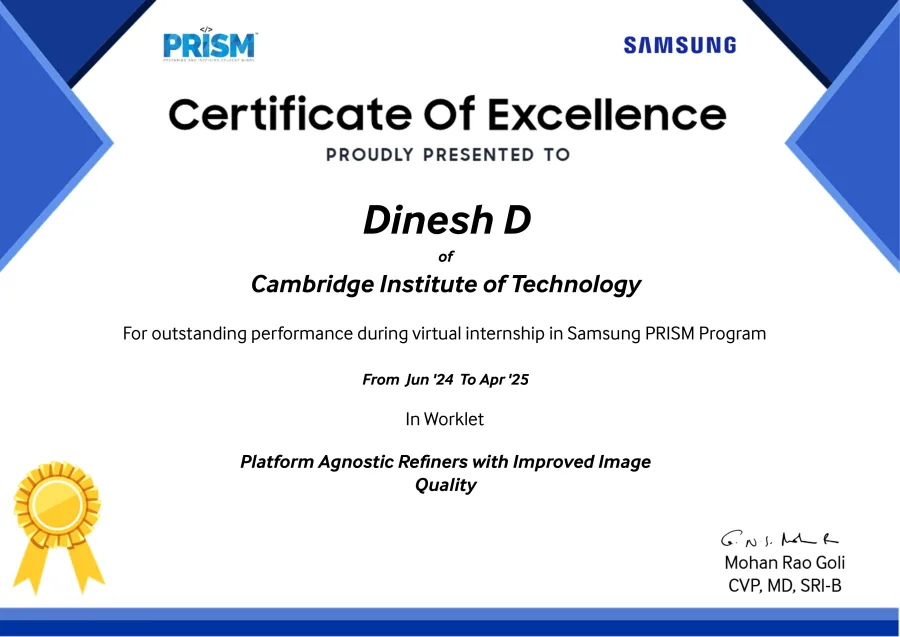
Samsung R&D Institute India Excellence Award recognition for the platform-agnostic Stable Diffusion engine.
Publishing and indexing these findings on Scopus formalizes how the broader ML community can deploy diffusion pipelines in headless, resilient cloud environments without legacy UI dependencies.
Sources
- Scopus Document Details - Platform-Agnostic Stable Diffusion for Advanced Image EnhancementACT 2025, Volume 2, Pages 5483-5495. EID: 2-s2.0-105034833094.
- ACT 2025 Proceedings - Advances in Computing, Control, and Telecommunication Technologies16th International Conference on Advances in Computing, Control, and Telecommunication Technologies.
Frequently asked questions
What is Platform-Agnostic Stable Diffusion?
It is a methodology and modular architecture that strips proprietary WebUI wrappers (such as Automatic1111 and SwarmUI) away from Stable Diffusion and SDXL checkpoints. By parsing safetensors directly and orchestrating CLIP encoders, UNet schedulers, and VAE decoders in pure Python, it achieves 40 percent faster generation and headless microservice deployment.
Where is this research indexed and how can it be cited?
The paper is published in the proceedings of the 16th International Conference on Advances in Computing, Control, and Telecommunication Technologies (ACT 2025), Volume 2, pages 5483 to 5495, and officially indexed on Scopus under Electronic Identifier EID: 2-s2.0-105034833094.
Attending an event or workshop in Bengaluru? Always happy to connect.
Get in touch