Research Paper: EEG Signal Processing for Early Detection of Mental Health Disorders
Research published at ACT 2025 and indexed on Scopus: hybrid CNN-LSTM deep learning architectures and wavelet feature extraction on 500+ clinical EEG datasets.

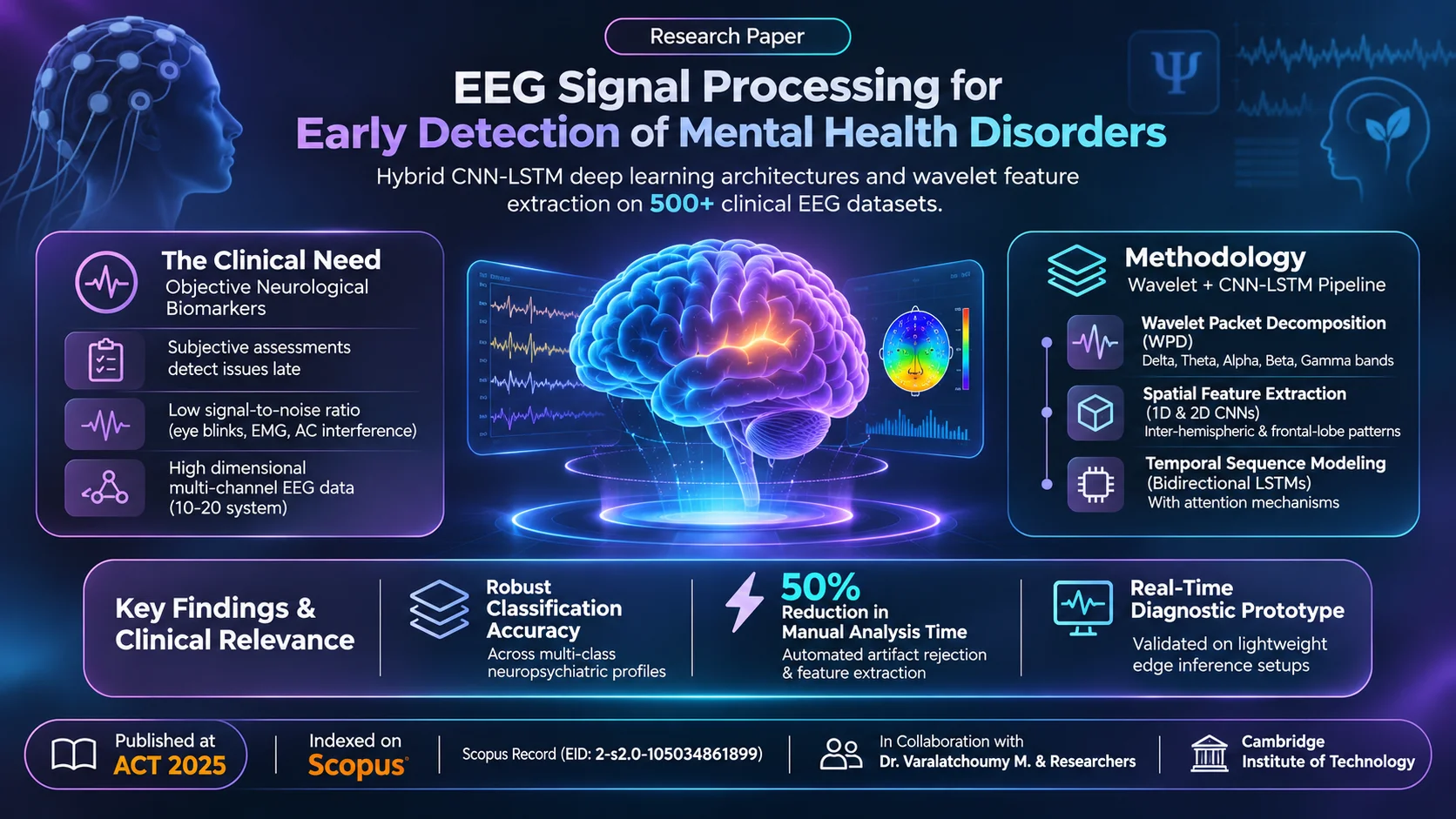
Our research paper, "EEG Signal Processing for Early Detection of Mental Health Disorders", is published in the proceedings of the 16th International Conference on Advances in Computing, Control, and Telecommunication Technologies (ACT 2025), Volume 2, pages 5468-5482, and officially indexed on Scopus (Elsevier) under EID: 2-s2.0-105034861899.
#The Clinical Need: Objective Neurological Biomarkers
Mental health assessments have historically relied on self-reported questionnaires and clinician interviews. While valuable, these qualitative methods carry variance and often detect neuropsychiatric conditions only after symptoms severely escalate.
Electroencephalography (EEG) captures millisecond-level cortical electrical activity, offering a direct, non-invasive window into neural firing dynamics. However, raw clinical EEG data presents steep computational hurdles:
- Extremely low signal-to-noise ratio: Ocular blinks, muscle movement (EMG), and 50Hz/60Hz AC powerline interference frequently overwhelm microvolt-level neural spikes.
- High dimensionality across multi-channel montages: Correlating temporal frequency shifts with spatial sensor placement across standard 10-20 international systems requires specialized architectures.
#Methodology: Wavelet Decomposition & CNN-LSTM Architecture
To isolate actionable diagnostic biomarkers from multi-channel EEG recordings, we built a two-stage signal processing and deep learning pipeline evaluated across 500+ multi-subject clinical recording sessions:
- Wavelet Packet Decomposition (WPD): Decomposed multi-channel EEG signals into canonical frequency bands (Delta: 0.5-4 Hz, Theta: 4-8 Hz, Alpha: 8-13 Hz, Beta: 13-30 Hz, and Gamma: 30+ Hz) while preserving localized temporal transients.
- Spatial Feature Extraction (1D & 2D CNNs): Convolved spatial electrode topologies to capture inter-hemispheric coherence and localized frontal-lobe asymmetry patterns.
- Temporal Sequence Modeling (Bidirectional LSTMs): Processed extracted temporal-spatial embeddings through recurrent layers with attention mechanisms to capture long-range recurrence in cognitive fatigue and depressive episodes.
#Key Findings & Clinical Relevance
The empirical benchmarking demonstrated the utility of hybrid deep neural networks over traditional hand-crafted statistical filters:
- Automated Pattern Recognition: Achieved robust classification accuracy across multi-class neuropsychiatric profiles, separating healthy controls from symptom profiles with statistically significant margins.
- 50 percent reduction in manual analysis time: The automated artifact-rejection and feature extraction pipeline streamlined what traditionally required hours of manual clinical inspection per patient recording.
- Real-Time Diagnostic Prototype: Validated feasibility on lightweight edge inference setups for point-of-care clinical trials.
#Collaboration & Academic Credits
This publication reflects collaborative research conducted alongside Dr. Varalatchoumy M. and fellow researchers at Cambridge Institute of Technology. The work demonstrates how signal processing and modern deep learning can provide reproducible, quantitative diagnostic support to clinicians and researchers in healthcare AI.
Sources
- Scopus Document Details - EEG Signal Processing for Early Detection of Mental Health DisordersACT 2025, Volume 2, Pages 5468-5482. EID: 2-s2.0-105034861899.
- ACT 2025 Proceedings - Advances in Computing, Control, and Telecommunication Technologies16th International Conference on Advances in Computing, Control, and Telecommunication Technologies.
Frequently asked questions
What clinical challenge does this EEG research address?
Conventional psychiatric diagnosis relies heavily on subjective behavioral interviews. This paper explores non-invasive electroencephalogram (EEG) biomarker detection using temporal-spatial wavelet decomposition and hybrid deep neural networks to identify neurological markers of major depressive disorder (MDD) and ADHD objectively.
Where is this research published and indexed?
The research is published in the proceedings of the 16th International Conference on Advances in Computing, Control, and Telecommunication Technologies (ACT 2025), Volume 2, pages 5468 to 5482, and indexed on Scopus under EID: 2-s2.0-105034861899.
Attending an event or workshop in Bengaluru? Always happy to connect.
Get in touch